










we integrate sustainable strategies that help organizations flourish.
Planning
Implementation
Many of the aforementioned services can be provided independently or as part of a larger project. In other words, if you’re just looking to explore what sustainability means for your organization at a high level, we can rightsize the project to meet your needs.
Sustainability is about thinking in long terms, which means more than quarterly profits. Our focus is on long-lasting strategies that are woven into the fabric of the organization. They will help you achieve existing organizational goals rather than creating a whole new set of goals that don’t align with your mission or vision. Our approach is targeted and specific to you and incorporates the always unique aspects of your organization.
Static
These are typically one-time changes to a process, software or infrastructure that produce long-lasting results. The focus is on finding the low-hanging fruit that will produce immediate results with short paybacks and high ROIs. The quick wins build momentum throughout the organization.
Dynamic
Our dynamic strategies engage people in a meaningful and rewarding way so that sustainability becomes part of the organizational culture. We use a bevy of research-supported methods to engrain the sustainability mindset into the organization and move the entire organization forward.
First and foremost, we only work with organizations where we are sure we can add value. There must be a clear avenue for us to help and your organization should be poised and ready to move forward. The challenge many experience is how to move forward, which is where we come in. Our approach is a good fit for a range of shapes and sizes. Whether you are large and complex, small and family-owned, or a government entity, two commonalities hold true: there’s a need for sustainability expertise and experience, and a desire to pursue the opportunity.
Let’s not kid ourselves; profitability is immensely important and is undoubtedly a key focus, but there’s much more to making an organization successful. You’ll start to flourish when you decrease energy and material waste, bolster your reputation, mitigate risks, reduce operational emissions, make raving fans out of your employees and clients, and increase market share. Yes, believe it or not, all of these things can happen as a result of integrating sustainable strategies into your organization’s fabric. Ultimately, it’s about making choices that are good for profits, people and the planet.
Our work with the state of Nebraska's largest school district (47,000+ students and 7,300+ staff) began in late 2009 when we completed an Energy Action Plan. The Plan's foundation was an ENERGY STAR rating for every school; upon which several energy and resource conservation strategies were built. Opportunities for increased efficiency were identified in several areas, and the Plan specified strategies to save money and improve the district's environmental footprint.
Once the Plan was completed, the school district asked us to take the lead in implementing many of the strategies contained therein. We have been serving as the District's sustainability coordinator since July 2010 and have established the District's Green Schools Initiative. It's an endeavor that engages not only internal staff and administrators, but also includes students, parents and other community members.
During the first twelve months we created the infrastructure to support the Initiative longer-term, sought out and implemented specific energy saving opportunities, and assisted the district with a major lighting retrofit, which was the top recommendation from the Energy Action Plan.
Our work as of late has focused on engaging schools on a one-on-one basis. We have been able to shift policies at a District level and work to implement those changes on the ground. Engagement levels of the district's administrators, faculty, staff, and students are exceeding expectations.
But the proof is in the pudding. The district's cumulative energy savings over the last 26 months are $2.7 million. Emissions are down dramatically. Landfill waste is at a seven-year low, and local and national awards are starting to stream in. The Omaha Public Schools project has proven to be an excellent marriage of operational efficiencies coupled with organizational engagement.
To learn more about the project, check out the full case study at right.
Our work with the Omaha Public Schools has proven to be an excellent marriage of operational efficiencies coupled with organizational engagement. It's been an absolute treat to work with Omaha's youth.
Craig Moody
Principal and Project Manager
Verdis Group
Early in 2010, The Nebraska Medical Center learned that it was paying more per square foot in energy costs than the national average for hospitals; this despite the fact that Omaha's energy prices are among the lowest in the country. The Nebraska Medical Center was consuming far more energy per square foot than their national counterparts and something needed to change.
Our work began soon thereafter with an ENERGY STAR benchmarking of the entire campus; one of the more complex benchmarking exercises we’ve undertaken with 33 buildings and 4.2 million square feet included. The results clearly showed opportunities for energy efficiency increases were plentiful.
While completing the benchmark, we began facilitating The Nebraska Medical Center's green team: the Energy Advocates. It was an initiative just getting off the ground, and our effort focused on helping the team identify and prioritize energy-saving activities, creating a communication campaign, and administering a baseline survey. Through our partnership with The Nebraska Medical Center's team of volunteers, we were able to engage folks from across the organization in conserving energy.
An important element in the organizational engagement process was the use of our Pledge Tool. The Nebraska Medical Center teamed up (competed) with UNMC on an organization-wide pledge to conserve energy and resources. The tasks to which pledgees committed were simple yet impactful. Our online pledge platform provided an easy means by which nearly 5,000 people could participate, and its unique, automated email reminders and public recognition component have ensured that pledgees stick to their commitment.
Soon after completing the ENERGY STAR benchmarking, The Nebraska Medical Center's executives asked us to develop an Energy and Sustainability Master Plan. Using the Green Guide for Healthcare's Operations Pilot as a foundation, we partnered with Kiewit Building Group to benchmark The Nebraska Medical Center's performance versus the GGHC's LEED-like requirements over a total of 136 credits in categories such as Sustainable Sites, Transportation, Waste Management and Environmental Services.
The final Energy and Sustainability Master Plan identified organizational energy and sustainability goals, and outlined a three-year strategy for achieving increased efficiency, reducing waste, lowering emissions and saving oodles of money.
Today we remain actively engaged in leading the Energy Advocates and are partnering with The Nebraska Medical Center on several of the strategies and initiatives that were laid out in the Energy and Sustainability Master Plan.
To learn more about the project, check out the full case study at right.
Working with the Verdis team has been a valuable experience for us. Not only have they been a tremendous help in organizing our sustainability initiative, they have helped us lead a change in culture which has been truly amazing. They have been, and continue to be, an outstanding partner.
Don Futrell
Executive Director - Facilities
Management & Planning
The Nebraska Medical Center
Verdis helped us achieve a shift in culture that we could never have achieved on our own. Having their expertise on our side was absolutely critical to the success of such a large initiative.
Brandy Olson
Manager, Operations/Logistics and Process Improvement
Perioperative Services
The Nebraska Medical Center
Our ongoing work with the University of Nebraska Medical Center generally falls into three categories: Organizational Engagement, Sustainability Master Planning, and Project Implementation. This three-fold approach continues to produce excellent results: reducing costs, curbing emissions, and engaging thousands of employees across the campus.
Our Organizational Engagement approach leverages our extensive knowledge in behavior change and employee engagement. We work closely with UNMC’s green team, LiveGreen, to build a campus of sustainability champions in every department. UNMC and The Nebraska Medical Center used our online Pledge Tool to hold a campus-wide pledge to conserve energy and resources. Nearly 5,000 participated, and the tool's unique, automated email reminders and public recognition component ensured follow-through.
The second element of our work with UNMC is the creation of their first-ever Sustainability Master Plan. There is a very strong connection between sustainability and health, and UNMC’s Plan will help them leverage and build upon this connection. The Plan charts a 10-year course and includes baselines, goals, and strategies in the areas of greenhouse gas emissions, energy, water, campus planning, materials, transportation, dining, and campus engagement.
Finally, the types of things we explore within the realm of Project Implementation have been quite varied. From mapping out a major
enhancement to the campus’ recycling process, to developing a request for proposal for waste hauling services; we are able to focus our expertise and resources where they are most needed.
The University of Nebraska Medical Center, much like all other governmental entities, is stretching for every dollar, and they view our work as an integral part of their quest to conserve energy, save money and minimize their environmental impact.
To learn more about the project, check out the full case study at right.
The Verdis team offered invaluable support and guidance as we moved forward with our green efforts. Their methods are backed by research, and they have strong knowledge of how to enact behavior change on a large scale. Thanks to Verdis, we now have an initiative that benefits the environment, saves money, and increases employee satisfaction.
Melanie Stewart
Research Resources Manager
LiveGreen Coordinator
UNMC
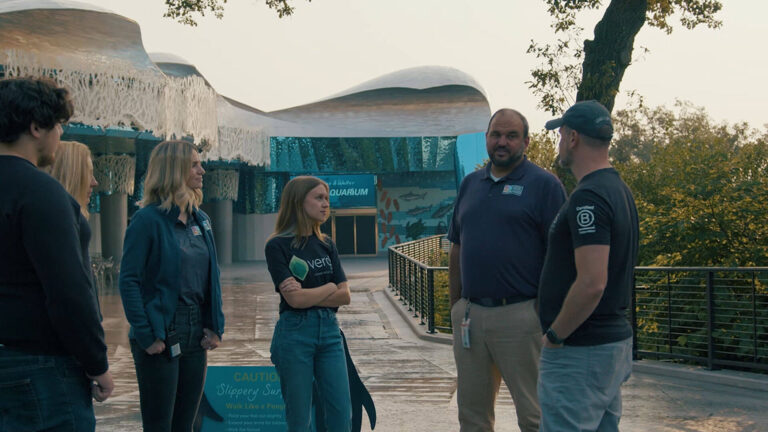
Our work with the state of Nebraska's largest tourist destination began in January 2012. Over the course of the first five months, we created their first ever Sustainability Master Plan, which pinpoints opportunities for increased efficiency across all areas of the Zoo's operations. The Master Plan incorporated input from a plethora of sources, including but not limited to: Zoo staff from all levels, best practices at other zoos, surveys of both staff and the public, site visits, and loads and loads of data. We collected and analyzed quite a bit of information and boiled it down to the most relevant opportunities.
Naturally working with a zoo presents a whole new batch of unique challenges and opportunities to consider that don't necessarily apply to a traditional office setting. After all, we don't recall the last time we saw a giraffe forget to duplex print a TPS Report. The Zoo is preparing for growth, both in attendance and in square feet. Its conservation-based mission presents a great opportunity for us to look for innovative strategies that provide environmental, economic, and community benefits.
As the Master Plan wrapped up, we turned our attention to implementation and engagement, which has kept us and our key stakeholders at the Zoo busy. We rolled out the online Pledge Tool, applied for and were awarded grants to ramp up recycling efforts, led a lighting retrofit, and helped the Zoo set up a Green Revolving Fund.
We continue to be involved as the Zoo pushes its way through the early stages of major implementation efforts. They had many conservation-related successes prior to our partnership; leveraging those to reduce energy and resource consumption is happening successfully. The Zoo is off and running.
To learn more about the project, check out the full case study at right.
We wanted to take an organized, well-thought-out approach to improving sustainability, and Verdis fit the bill perfectly. They brought multiple disciplines together to create our plan, implement action steps, and change the way our entire organization thinks on an individual level about the wise use of precious resources.
Dennis Pate
Executive Director and CEO
Henry Doorly Zoo
The state of Nebraska's largest community college, Metropolitan Community College (MCC) has seen their Institute for the Culinary Arts really elevate the community-wide conversation around food. As such, they have taken a particular interest in Omaha's urban agriculture scene and solicited our help in further ascertaining what role it should play moving forward.
Our first assignment was to facilitate a workshop wherein many of Omaha's movers and shakers in the urban agriculture community, about 40 in all, were asked to think about and build consensus around what Omaha's urban agriculture future holds. It was a fascinating discussion and despite the group's often diverging opinions, they were able to agree upon five guiding principles for the urban agriculture system of tomorrow.
But the vision and excitement coming out of that meeting needed a champion to carry it forward, and MCC was interested in determining specifically what role it should play in moving forward. As such, we helped MCC gain clarity on its role moving forward by conducting several interviews, conducting research, and completing a stakeholder summary report that succinctly and clearly outlined how several stakeholders felt MCC should proceed.
Once again, we found ourselves ring-leading a complex situation: meeting with stakeholders, building consensus, supplementing our findings with supporting research, and providing guidance for MCC to move forward. Urban agriculture systems are complex and involve many different parties. On behalf of MCC, we are bringing them all to the table to plant the seed of an urban agriculture system in Omaha. Let's eat!
Metropolitan Community College is doing great things in the urban agriculture community, and we were particularly excited about helping them really focus their efforts. It's an important step forward for such an important institution.
Chris Stratman
Senior Associate & Project Lead
Verdis Group
Many cities and counties are exploring ways that they can incorporate sustainability into their master plans. The first and most important place to start is by looking at energy and including an Energy Element in the master plan. To date we have worked on two such projects.
First, Sarpy County. It may be the smallest county in Nebraska, geographically, but it is also the fastest growing in terms
of population. In the spring of 2011, Sarpy County recognized the potential to save money by reducing energy, and sought a project team to complete an energy element for the county's master plan. Verdis was awarded the contract for this important endeavor, alongside our frequent teammates at Lamp, Rynearson & Associates and Steven Jensen Consulting.
Our focus on the team was to analyze the county’s energy data and identify strategies by which the county and its citizens could be more energy resilient. Such an approach involved both in-depth number crunching and facilitating a coalition of 30+ stakeholders: a two-fold approach the proved to be highly effective – the team recently won an award for the project from the Nebraska Chapter of the American Planning Association.
More recently, we partnered with RDG Planning & Design to prepare the energy element of the City of Papillion’s master plan update. The focus for our piece of the work was driven almost exclusively by data. We studied data from both the City operations and the city at-large, and developed a plan that synched up with what RDG was creating. The streamlined approach works well for cities and counties looking to incorporate energy elements into their planning processes.
To learn more about the Sarpy project, check out the full case study at right.
Incorporating an energy element into a city or county master plan shows stewardship of taxpayer resources, helps us be more energy independent and secure, and is good for the environment. I expect Sarpy will reap the rewards for many years to come.
Patrick McAtee
Senior Associate & Project Lead
Verdis Group
In November, 2010, Omaha was home to the first of four Conversation Conferences on Nebraska Environment and Sustainability developed and hosted by the Joslyn Institute for Sustainable Communities. Throughout 2011, three other Conversations Conferences were held in Lincoln, Grand Island, and Scottsbluff, NE. In total, over 450 Nebraska residents from across the state attended these four conferences to discuss sustainable resource use around the five topic areas of energy, food, land, water and materials.
One of our core values at Verdis is continuous improvement to stay on the leading edge of sustainable thought and practice. So when Daniel Lawse was invited to serve as the Statewide Resource Coordinator for the energy topic, he was honored to accept, given his extensive knowledge around energy issues and solutions. It offered him not only an opportunity to travel across our great state listening to Nebraskans discuss energy in their community, but a chance to share his thoughts on how Nebraska communities can prepare for a more secure energy future.
In this role he attended all four conferences to facilitate and stimulate day-long conversations around energy with groups ranging from 15 to 40 Nebraskans. In addition, Daniel served as a consistent voice from one city to the next and as a resource for conference attendees if they had questions about energy issues between conferences. After the last Conversations Conference, he wrote a final summary report, portions of which were published in the statewide newspaper Prairie Fire.
As a result of these conferences, Nebraskans now have a better understanding of the state of our sustainability challenges and opportunities. These conversations have empowered attendees with new knowledge and connections to make positive changes in their own community--from something as simple as talking with their neighbor about saving energy to more comprehensive changes such as finding ways their business can be more energy efficient or creating local and state policies to help their communities flourish.
We were extremely pleased to have the opportunity to hear so many Nebraskans who are aware of energy opportunities in their community. I witnessed first-hand the resourcefulness and creative problem solving of Nebraskans. Every conversation was filled with hope for a better energy future in the state.
Daniel Lawse
Principal
Verdis Group
One of Omaha's newest nonprofits, the Omaha Community Center for Sustainability (OCCS) is a catalyst for change in the Omaha community towards a more sustainable future. To that end, the OCCS promotes a more environmentally sustainable way of life by transforming attitudes and decision-making among consumer, business, civic, and political communities.
We have been involved in the development and subsequent activities of the OCCS in three primary ways. First, in early 2010 we completed a major gap & compatibility analysis that painted a broad picture of the green landscape in Omaha. It also identified several national and international models for other similar centers.
Second, we partnered with HR&A Advisors of New York and Lamp, Rynearson & Associates of Omaha to complete an in-depth strategic plan for the OCCS. Our primary focus was drilling down deeper on a few of the sustainability center models we identified previously with a particular eye on the details of their physical and organizational development.
Finally, we worked with the University of Nebraska-Omaha and the Peter Kiewit Institute to prepare a strategic plan and subsequent University of Nebraska Board of Regents proposal to create an
Urban Sustainability Center within the University. We sifted through information and insight obtained over the course of several dozen interviews and hours of research to zero in on the Center's unique and compelling value position. The Center was approved in late 2012.
All three efforts required in-depth research, conversations with hundreds of current and potential stakeholders, consensus building, and ideating paths forward for multiple organizations. Quite simply, we're ring-leading a complex project. And we're good at it.
Verdis has been instrumental in the conception and development of the Center for Sustainability at the University of Nebraska. Without their involvement this project would still be at the starting gate.
Fred Amis
Chairman
Omaha Community Center for Sustainability
The cornerstone of our work and the foundation of every good sustainability initiative is an energy and sustainability master plan. Our catered, comprehensive and collaborative approach generates a road map of strategies that will align sustainability with your organizational mission and goals.
The process begins with the collection and analysis of several different datasets in order to establish important benchmarks. We help you identify where you stand today, determine what your core environmental and social impacts are, benchmark your resource consumption patterns and greenhouse gas emissions, and establish the foundation upon which to build your plan and measure future progress.
We work with people throughout your organization to compare energy and sustainability benchmarks versus the broader, overarching organizational mission and goals. Sustainability is best viewed as a strategy by which an organization can achieve its full potential. Every organization is different with distinctive sets of values and aspirations, and aligning it all is critical.
With the foundation built, we engage key stakeholders in developing and prioritizing the goals and strategies of the Energy and Sustainability Master Plan. The completed Plan is thorough yet succinct and includes all the right elements to help you take advantage of the sustainability opportunities most applicable to your organization. It’s a road map that will tell you where you’re going and how to get there.
Creating a path forward via the Master Plan is an important outcome, but a good plan doesn’t truly result in any tangible results; it must be rolled out and implemented. We use research-supported strategies to engage the entire organization and build a culture that unabashedly adopts sustainability as a key strategy, and we help you get busy implementing all the strategies outlined in the Master Plan.
As part of the master planning process, we develop tools that make it easy to track your progress. It’s important to regularly and frequently take stock of what has been accomplished and where you’re headed next. As we learn together, we can consider revisions to the path forward in light of the information at hand. Things can change, and we’ll help you be resilient and adaptable.
Once you've taken a great leap forward and have successes to tout, it's time to shout it from the rooftops. We will help you cater your message to your target audience. Whether they are customers, citizens, students or attendees, the steps you've taken will make them more loyal to your organization.
Every organization seems to occasionally have an issue or two arise that require some in-depth analysis. When it comes to sustainability, we can help make the research and analysis more accurate, efficient and complete.
We understand that not every organization has either the capacity or the aspirations to line the rooftop with solar panels. That’s why we align all of our work with your organization’s current mission and goals and cater the sustainability strategies accordingly, in essence helping you find the shade of green that best suits your organization.
Back in January, my amazing wife, Emily, and I were asked to be honorary co-chairs of the Inclusive Communities Humanitarian Dinner; a request that completely blew me away. When you see the list of past honorary chairs, it’s pretty clear we don’t belong on the list. Nevertheless, when we learned our co-chairs were Michael and Laura [...] Read More »
I’ve been on the Board of Trustees of the Business Ethics Alliance for a few years now, and I’ve always enjoyed the programs and conversations that the BEA hosts. They’ve recently taken the conversations online and launched a blog. Dr. Beverly Kracher, the BEA’s fearless leader, asked me to write a piece that pertained to [...] Read More »
Yesterday I attended the Greater Omaha Young Professionals Summit at the Century Link Center. I think that the focus of the summit was to get young professionals involved in their community. Well, hook, line, and sinker-they got me. More on that in a minute. I did learn about issues that I don’t [...] Read More »
We held our annual retreat a week ago. It was a great opportunity to collectively extract ourselves from the standard day-to-day fare and give some thought to who we are and where we’re going. We started the day by reaffirming our vision, mission and values. In doing so, we came to two conclusions: first, we [...] Read More »
Just before all the snow melted in the middle of January, I walked to pick up my daughter from her first day back at school after the holiday break. The first thing she did when we started to walk off the school property was ask if she could put on her boots because there was [...] Read More »